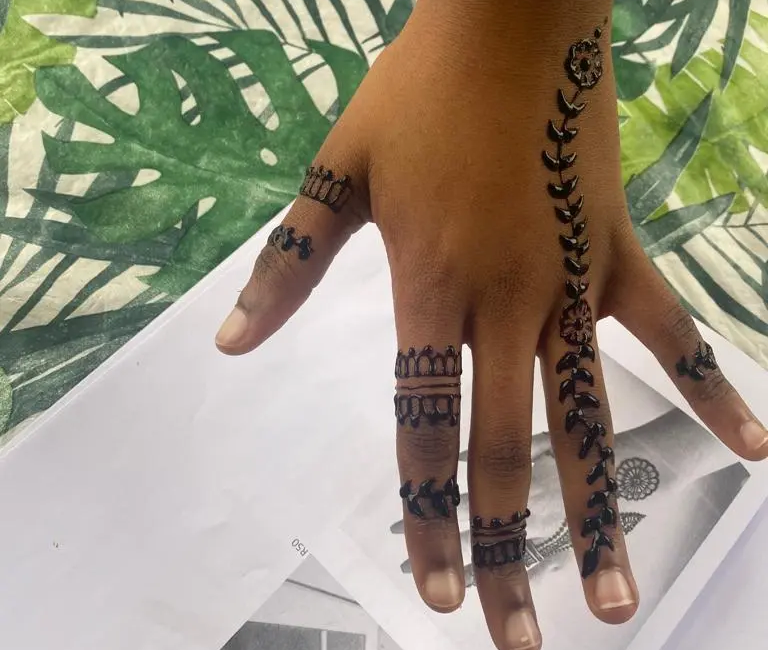
Currently pursuing her pharmaceutical studies at Rhodes University, Celeen Rama Chandran is a henna artist. She has been familiar with the art of henna since her youth, recalling its traditional application for brides and their families.
“Henna is not exclusively a religious or cultural practice. It serves as a method of beautification to enhance one’s appearance,” Chandran told Affirmations Media.
I would say Henna art is presently popular as an adornment
for weddings and other cultural celebrations in India, South Asia, the
Middle East and Africa – pretty much across the world nowadays,” Celeen Rama Chandran.
She recognised that her deceased aunt was instrumental in her path towards henna artistry. Through this art form, Celeen developed a profound bond with her aunt, cherishing the happy moments they experienced together as her aunt motivated her to experiment with different henna designs.
In light of financial challenges, Chandran initiated her henna artistry into business during 2016 and 2017 while she was a student at the University of Witwatersrand. This venture was intended to ease the financial strain on her parents and provide her with a source of income. Reflecting on this difficult time, she remarked that her henna work allowed her to generate enough revenue to cover her daily expenses. Although she did not initially view it as a formal business, she observed a gradual increase in her customer base over time.
Chandran recognised the obstacles she encountered as a henna artist, especially in convincing her parents to endorse her project. They voiced concerns regarding her academic performance, a common worry among parents. However, after showcasing her enthusiasm for henna as a hobby and successfully persuading her parents, they eventually granted her permission to pursue this initiative while earning her own income.
Life at Rhodes University as a henna artist.
At Rhodes University, Celeen notes that the audience is significantly more open, which could account for her heightened engagement in comparison to the two years she spent at Wits. She has drawn in a larger customer base and has gained from a strong support system offered by her friends.
“Without my friends, who have generously helped promote my business without charge, I question whether I would have been able to make henna a successful venture here at Rhodes University,” she said.
Celeen noted that she is not particularly active on social media, which may present a challenge for her business. However, she is pleasantly surprised by her ability to attract customers, primarily due to her friends who promote her services.
One major challenge she encounters in her henna business is time management. As a full-time student, Celeen recognises the difficulties that come with this. Furthermore, as a final-year student, she is committed to ensuring that her business does not interfere with her academic obligations. She believes that when one is passionate about a pursuit, time becomes less of a burden. One naturally discovers opportunities to engage in it, whether on weekends or in the evenings after a long day of studying. “Balancing my studies with henna has become therapeutic for me, making time less of a concern,” Celeen stated.
According to Celeen, the process of applying henna is not as intimidating as it may seem, especially for those who have grown up with it. Typically, it takes her about thirty minutes to complete a henna design, although this duration can vary depending on the complexity of the design. “It is often advantageous when customers have a clear idea of what they want, but the joy lies in meeting individuals who are unfamiliar with henna and are curious to see how it will look on their skin,” she elaborated.
Celeen has been pleasantly surprised by the enthusiastic reception of henna at Rhodes. She has met individuals from diverse backgrounds who are fascinated by the art form and eager to experience how it appears on their skin.
Through this enriching experience, Celeen contemplates the inherent beauty of henna. It acts as a medium for connection and expression.
Henna: Its History and Cultural Significance
The art of henna, referred to as ‘mehndi’ in Hindi and Urdu, boasts a profound history that extends over 5000 years across regions including Pakistan, India, Africa, and the Middle East. Originally, it was esteemed for its natural cooling properties, which were particularly advantageous for those living in dry desert climates. A paste was formulated to soak the palms and soles. Moreover, Henna had medicinal applications, being used to relieve a range of ailments such as stomach discomfort, burns, headaches, and open wounds.
As the temporary staining capabilities of the paste became apparent—thanks to the presence of lawsone, a reddish-orange dye that bonds with the skin’s keratin—henna transformed into a decorative art form, becoming available to people from all walks of life.
In modern times, henna is primarily used during festive occasions like weddings and birthdays, promoting joyful celebrations. The henna paste symbolises health and prosperity in marital relationships, with certain cultures believing that a darker stain indicates a stronger love between partners.
It is crucial to understand that henna designs are distinct from tattoos; while tattoos are permanent due to ink penetrating the skin, henna is a temporary dye that stays on the skin’s surface. Additionally, Henna is also utilized for the safe colouring of hair, nails, and various textiles, including silk, wool, and leather.