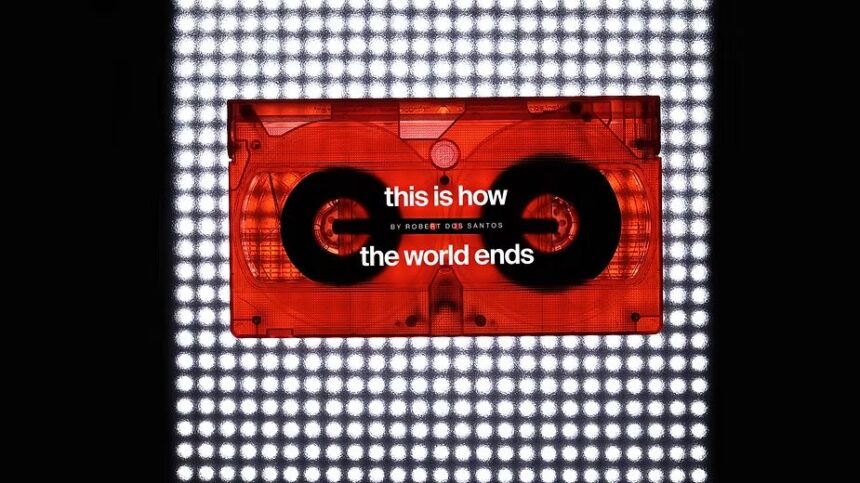
As the global community confronts the ‘colonisation’ of various sectors by Artificial Intelligence (AI) companies, a South African production company, And Films, has garnered significant attention online for its recent revival of Video Home System (VHS) tapes as a ‘Deliberate Middle Finger To AI’.
And Films, established by Robert Dos Santos, an experienced producer and director, is an independent film production company based in Cape Town. It is recognised for its exceptional cinematic visual style. This production specialises in the production of feature films, commercials, and trailers. Recently, it has garnered attention not only for its outstanding work but also for the announcement of its feature film, “This Is How The World Ends”, which has premiered on VHS, marking it as one of the first direct-to-VHS releases globally in the past twenty years.
The film debuted on 7 June 2026, coinciding with International VHS Day.
Find out more about Affirmations Media Services.
Santos recently stated in a press release that “Straight to VHS” was once considered a derogatory term in the 1990s, implying that a film was not worthy of a theatrical release. However, that perception has shifted. Today, straight to VHS signifies something innovative, unique, and thrilling.
In an era dominated by AI, streaming services, and digital downloads, we have become disconnected from the essence of our love for cinema, the communal experience it offers, and the tangible films we cherish. “This dynamic is evolving as we introduce the first straight-to-VHS film in two decades, marking a revival of physical media. This Is How The World Ends represents the beginning of a transformative shift in the cinematic landscape,” he said.
“Made by humans, for humans, you can now hold, touch, and most importantly, own the films you want to buy,” he explained.
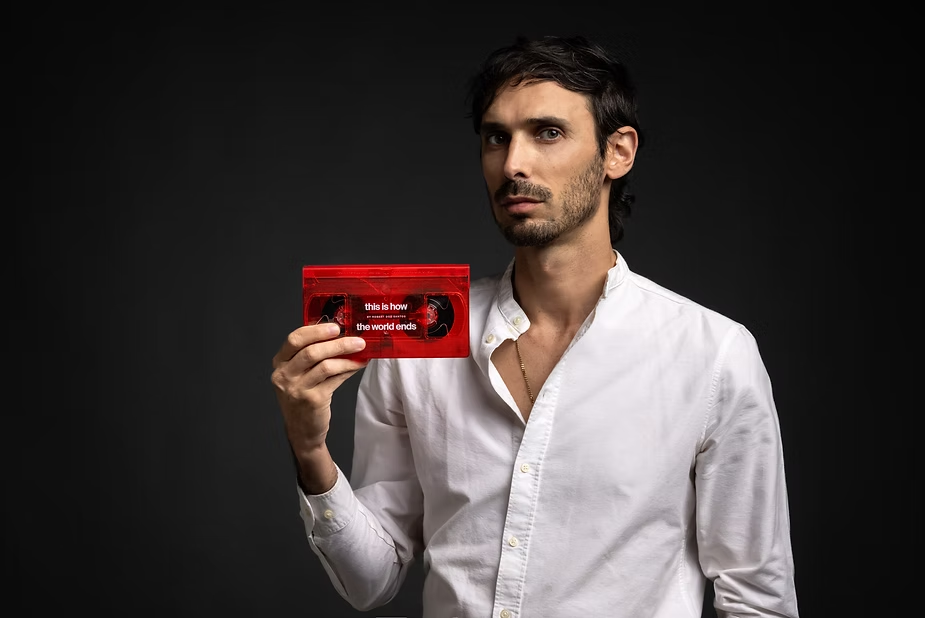
In an interview with Forbes Africa, he expressed that his choice to distribute the film through VHS was a conscious act of defiance against the growing digitalisation of contemporary entertainment.
This decision arose during a particularly troubling period, as reports indicate that AI companies are allegedly destroying books. This situation prompts critical enquiries: ‘Where do we stand now? What actions are we taking? What lies ahead? When will this cease?” These are pressing questions that individuals must contemplate.
The destruction of books occurs at a time when the global population is already struggling with reading, with an increasing number of individuals neglecting to engage with literature.
Marsha Lederman, writing for The Globe and Mail, writes that Artificial Intelligence is not only transforming our world but is also dismantling significant aspects of it, with the latest casualty being the cherished books we hold dear.
Anthropic, an American AI public benefit corporation based in San Francisco, California, is well-known for developing the Claude family of large language models. The organisation is currently engaged in training its Claude AI model, reportedly purchasing books to scan and assimilate their content.
Read Lederman’s full article (Click Here)
To execute this process efficiently and legally, specialised machinery is employed to sever the pages from their bindings for scanning, after which the remnants of the books are discarded. According to reports referencing court documents, Anthropic has acquired and destroyed millions of physical books in this endeavour.
However, Lederman notes that by purchasing these books, the company claims ownership, thereby circumventing concerns about copyright infringement that would arise from downloading pirated libraries.
The widespread acquisition and physical destruction of books by AI have been perceived by public opinion as profoundly unethical, as it regards irreplaceable cultural artefacts as mere disposable resources and undermines the intellectual rights of creators.
From both cultural and ethical perspectives, reports indicate that these AI companies are focusing on rare works, specifically targeting antique, out-of-print, and specialised academic books. Some of these texts are believed to be the last surviving copies of that knowledge.
This situation also highlights issues of monopolisation and the race for data contamination; by destroying physical copies, what remains for readers? Consequently, one is compelled to rely on these AI companies, which are unlikely to offer their services free of charge, unlike the experience of visiting an archive or library (to illustrate a point). These AI companies are intentionally positioning themselves as the exclusive gatekeepers of history and knowledge, dangerously enabling them to rewrite or edit historical truths without oversight.
Lederman concludes her article with a quote from the German poet Heinrich Heine, who prophetically stated in 1820, “When they burn books, they will, in the end, burn human beings too.”
While AI is undoubtedly a permanent fixture and serves as a tool for human use, it is disheartening to acknowledge that in this process, we as humans must sacrifice our most treasured possessions, such as nature, books, and nearly everything that we hold dear.
Amidst all this, it is refreshing to hear voices like Dos Santos, who produced his film on VHS, and to listen to him express the following sentiment during a recent interview with Forbes Africa: “First, as a creative, when everyone is moving in one direction, I think you should at least consider going in the opposite direction. That?s often where the most interesting ideas come from.”